BrandCat now supports trademark monitoring from ARIPO and OAPI.
That adds two African regional intellectual property systems to the same BrandCat workflow already used for other supported trademark offices.
ARIPO and OAPI are not the largest trademark sources in our coverage. The filing numbers are modest compared with CNIPA, USPTO, EUIPO, India, Russia, Brazil, or WIPO Madrid.
But they are still useful regional systems to watch if your brand has exposure in African markets, international licensing, consumer goods, software, education, pharmaceuticals, distribution, or cross-border portfolio activity.
Two African Regional Trademark Systems Added
The two new offices are:
- ARIPO - African Regional Intellectual Property Organization
- OAPI - African Intellectual Property Organization
They are different systems and they cover different legal frameworks, so BrandCat treats them as separate trademark sources.
That means ARIPO and OAPI each appear as their own database in BrandCat, with their own feature page, source label, result list, and detail views.
This is not just a naming distinction. It reflects how the data is organized and how the monitoring workflow is built.
Which Countries Are Covered?
ARIPO trademark coverage currently relates to the Banjul Protocol states: Botswana, Cabo Verde, Eswatini, The Gambia, Lesotho, Liberia, Malawi, Mozambique, Namibia, São Tomé and Príncipe, Tanzania, Uganda, and Zimbabwe.
OAPI covers 17 member states under the Bangui Agreement: Benin, Burkina Faso, Cameroon, Central African Republic, Comoros, Congo, Côte d'Ivoire, Gabon, Guinea, Guinea-Bissau, Equatorial Guinea, Mali, Mauritania, Niger, Senegal, Chad, and Togo.
Why ARIPO Matters
ARIPO trademark filings are handled through the Banjul Protocol on Marks.
ARIPO explains that the Banjul Protocol establishes a trademark application filing system where an applicant may file a single application either through a Banjul Protocol contracting state or directly with the ARIPO Office.
For monitoring purposes, ARIPO is useful because it can surface trademark activity that may not be obvious if you are only watching the largest national offices.
A relevant ARIPO filing can point to:
- regional African market activity
- local or cross-border brand adoption
- filings in markets that are easy to overlook
- possible conflicts around goods and services covered by your monitored marks
- activity that belongs in the same review workflow as larger offices
According to WIPO's office-level filing list, ARIPO is listed with 1,311 trademark class filings, ranking 131st among reporting offices for trademark filing activity.
That is not a huge filing volume. But it is still a regional filing route worth keeping visible when you are trying to reduce blind spots.
Why OAPI Matters
OAPI is also a regional intellectual property system, but it operates under a different structure.
OAPI describes the Bangui Agreement as the legal framework governing intellectual property within its 17 member states. The agreement establishes a centralized procedure for industrial property titles, including trademarks.
For brand monitoring, OAPI is useful because one relevant record can matter across a broader regional framework rather than just one national registry.
OAPI records can help surface:
- regional trademark activity in OAPI member states
- local brand conflicts
- market entry signals
- distributor or partner-related filings
- potentially conflicting marks that may otherwise stay outside the normal review habit
According to WIPO's office-level filing list, OAPI is listed with 12,793 trademark class filings, ranking 68th among reporting offices for trademark filing activity.
Again, this does not put OAPI anywhere near the largest offices globally. But it is enough activity to justify keeping OAPI inside a structured monitoring workflow instead of leaving it as a separate manual registry check.
Example: OAPI Results in BrandCat
BrandCat shows OAPI matches in the same structured result list used across the rest of the platform.
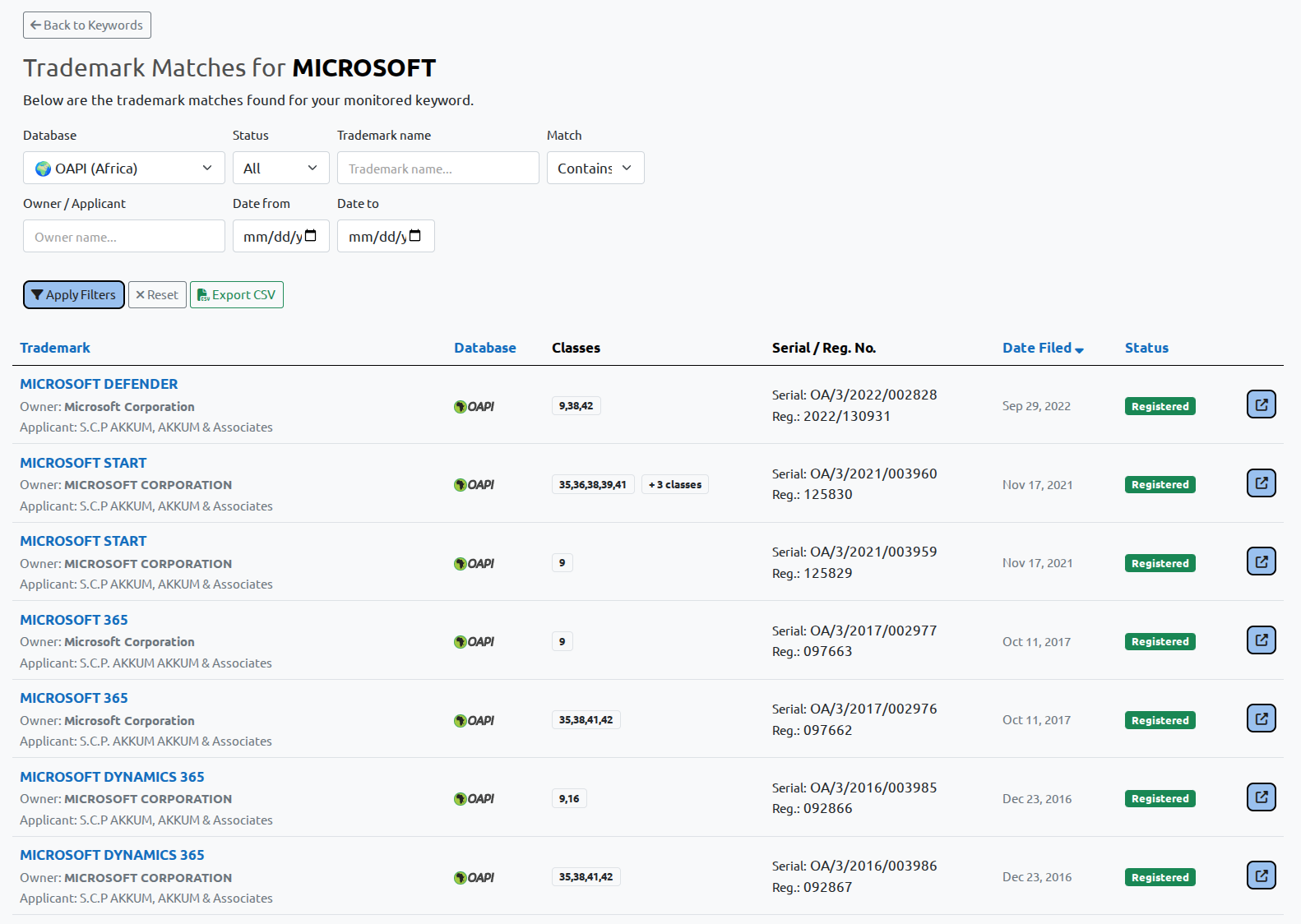
The results list includes the same practical review fields BrandCat already exposes for other offices:
- trademark name
- owner or applicant summary
- Nice classes
- serial or registration number
- filing date
- simplified status
- database source
OAPI records are generally Latin-script records, so this integration is not mainly about cross-script translation.
The useful part is simpler: OAPI records now appear in the same trademark monitoring dashboard as the rest of your coverage.
Example: ARIPO Results in BrandCat
ARIPO results are also shown in BrandCat's normalized result layout.
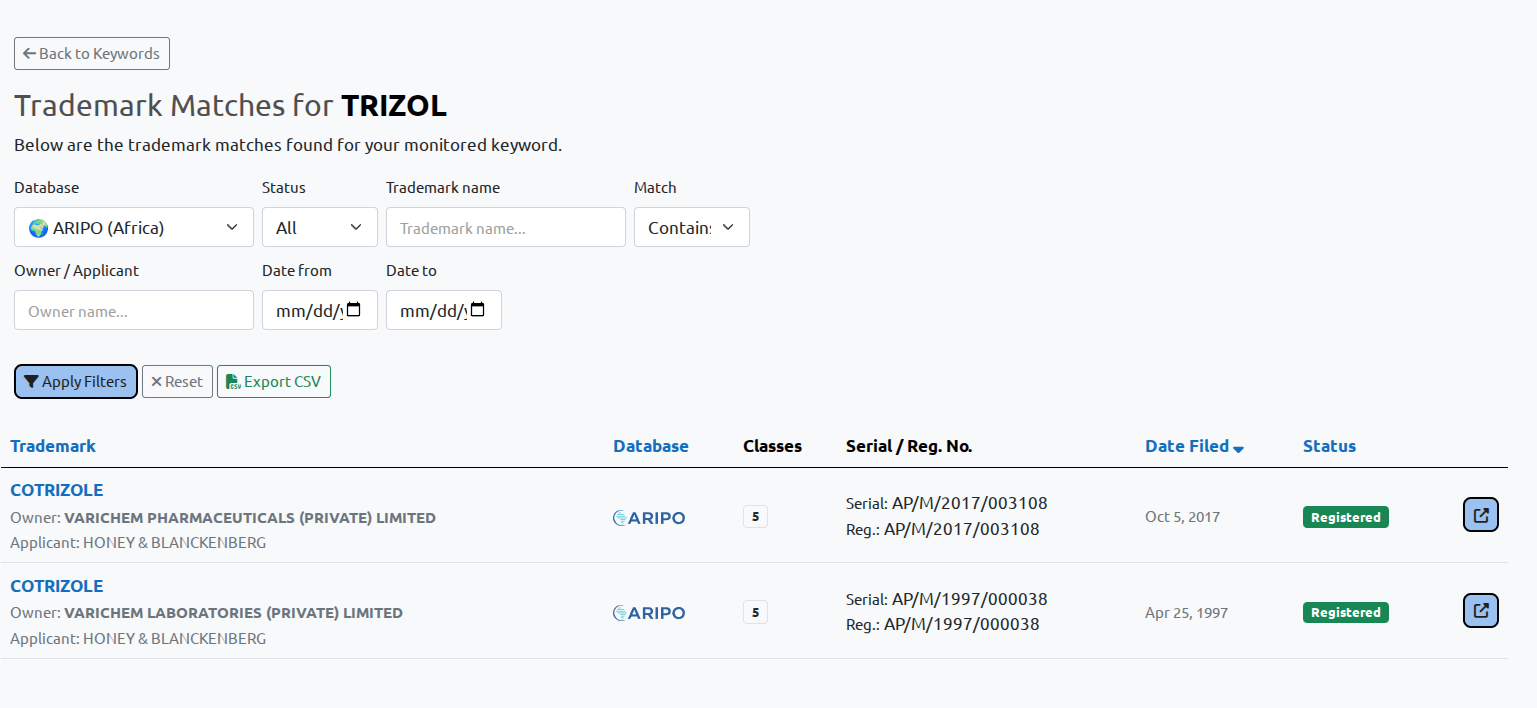
This makes ARIPO records easier to compare with results from USPTO, EUIPO, WIPO Madrid, CNIPA, India, Brazil, Russia, Hong Kong, Philippines, and other supported offices.
Instead of treating ARIPO as a separate registry to remember manually, relevant ARIPO records can now appear next to the rest of your monitored keyword matches.
Unified Trademark Detail Views
Each ARIPO or OAPI match opens into the same normalized trademark detail view used across BrandCat's other integrations.
Depending on the record, the detail page can include:
- serial number
- registration number
- original status
- simplified BrandCat status
- application date
- registration date
- expiry date
- owner information
- correspondent information
- Nice class details
- database source
That matters because the hard part of trademark monitoring is not only finding records.
The hard part is reviewing many records from many offices quickly enough to decide which ones actually deserve attention.
Example: OAPI Trademark Detail
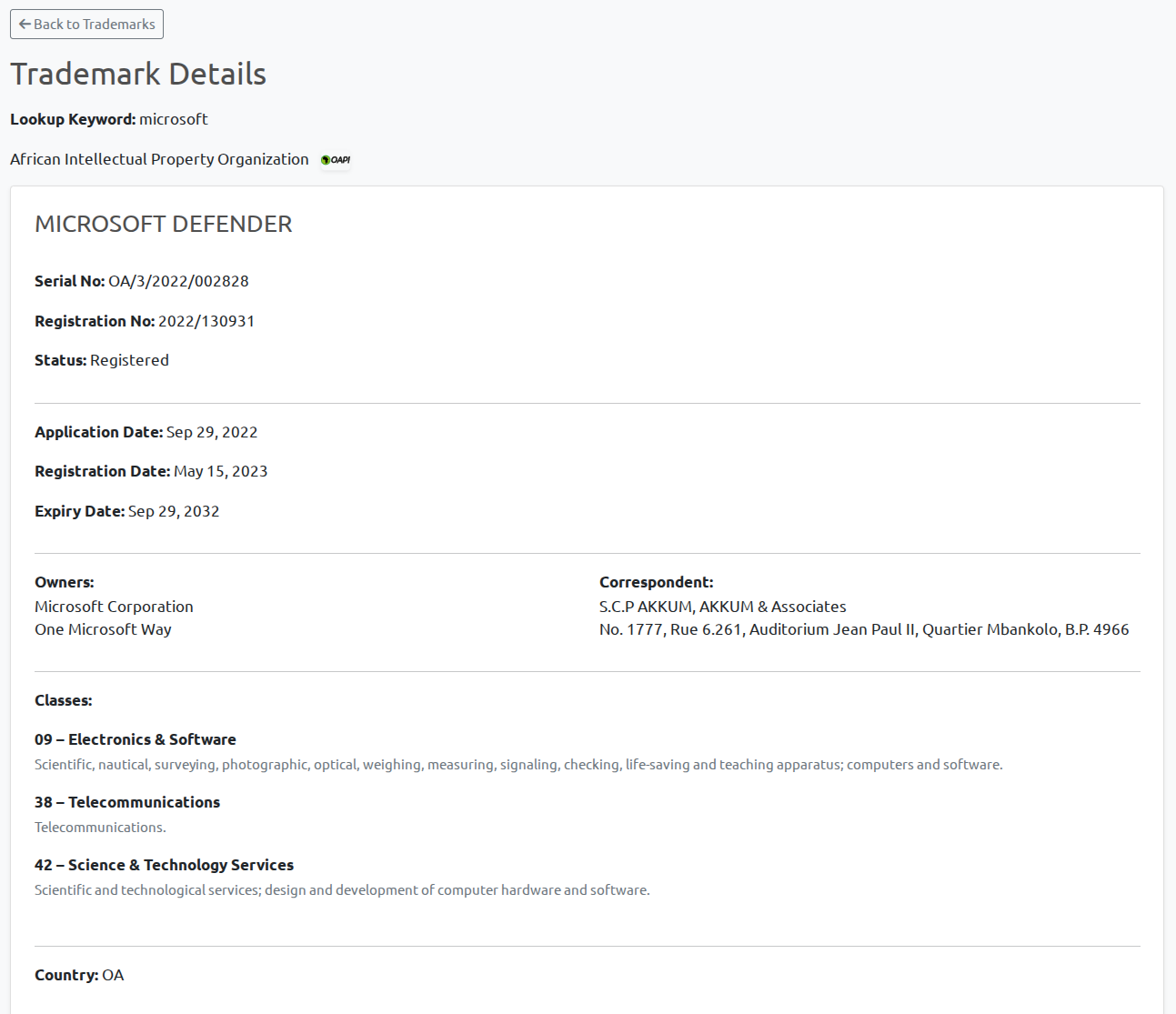
The detail view keeps the record comparable with other BrandCat sources, so you do not need to mentally re-parse another registry format just to answer basic review questions.
Example: ARIPO Trademark Detail
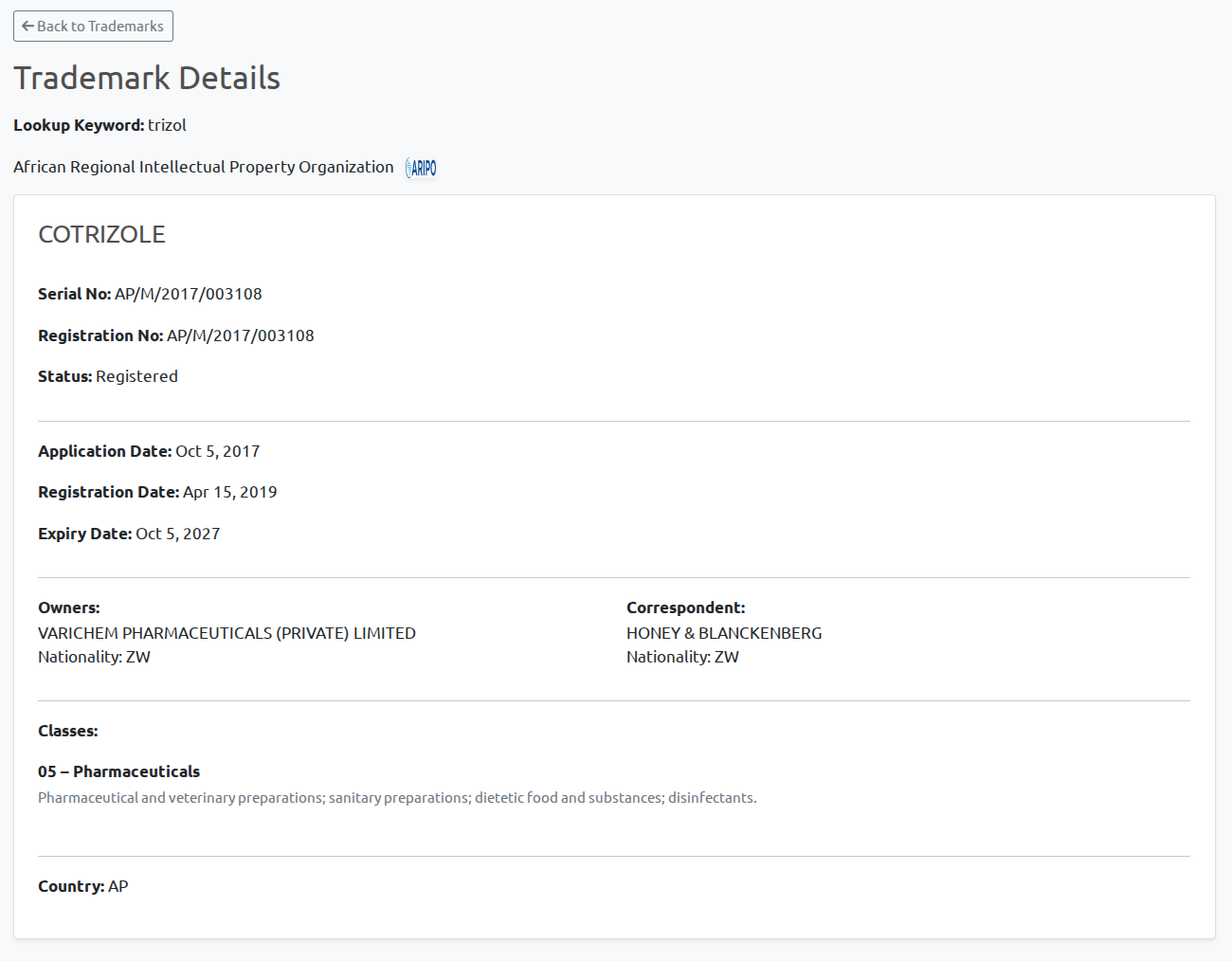
This is especially useful when you are reviewing multiple jurisdictions at once and need a consistent view of owners, dates, classes, status, and record identifiers.
What the ARIPO and OAPI Integrations Include
The new ARIPO and OAPI coverage includes:
- monitoring of trademark records from both regional systems
- matching against protected BrandCat keywords
- serial and registration number tracking
- filing, registration, and expiry dates where available
- owner and correspondent information
- Nice class classifications
- simplified status display
- normalized result lists
- unified trademark detail views inside BrandCat
Both offices are now part of the same broader BrandCat monitoring workflow.
No additional setup is required.
If you are already monitoring keywords in BrandCat, ARIPO and OAPI are now part of your coverage.
BrandCat's Growing Trademark Coverage
With ARIPO and OAPI added, BrandCat now monitors trademark activity across 20 jurisdictions and systems, including:
- 🇺🇸 USPTO - United States
- 🇨🇳 CNIPA - China
- 🇪🇺 EUIPO - European Union
- 🌍 WIPO Madrid System
- 🇬🇧 UKIPO - United Kingdom
- 🇯🇵 JPO - Japan
- 🇰🇷 KIPO - South Korea
- 🇮🇳 CGPDTM - India
- 🇧🇷 INPI - Brazil
- 🇨🇦 CIPO - Canada
- 🇲🇽 IMPI - Mexico
- 🇦🇺 IP Australia - Australia
- 🇨🇭 SwissReg / IGE - Switzerland
- 🇳🇿 IPONZ - New Zealand
- 🇭🇰 Hong Kong IPD - Hong Kong
- 🇧🇬 BGIPO - Bulgaria
- 🇷🇺 Rospatent - Russia
- 🇵🇭 IPOPHL - Philippines
- 🌍 ARIPO - Africa (new)
- 🌍 OAPI - Africa (new)
That gives BrandCat users a broader view of trademark activity across North America, Europe, Asia, Latin America, Oceania, and now two African regional IP systems.
Why This Is Useful in Practice
Trademark monitoring gets weaker when some offices are checked automatically and others are left as occasional manual searches.
Even smaller regional offices can matter when a filing overlaps with a protected brand, product name, app name, company name, or client portfolio.
ARIPO and OAPI are good examples of that.
They may not produce the filing volume of the largest global offices, but they can still reveal activity that is relevant for brands with African exposure or international ambitions.
With both offices now inside BrandCat, those records can be reviewed in the same workflow as the rest of your trademark monitoring.
That means fewer blind spots, less manual checking, and faster review of records that actually matter.
What's Next
We're continuing to expand coverage and improve how trademark data is normalized, reviewed, and matched across jurisdictions.
That includes ongoing work on:
- clearer status normalization
- better owner and applicant presentation
- improved cross-jurisdiction comparison
- cleaner detail views across different registries
- additional offices where they add real monitoring value
As usual, a lot of these priorities come from how real users actually use the product, not from a beautiful roadmap slide that looked good six months ago.
If there's a trademark registry you'd like us to prioritize next, let us know.
👉 Start monitoring: https://brandcat.io/sign-up
👉 ARIPO feature page: https://brandcat.io/features-trademark-monitoring/office/aripo-africa
👉 OAPI feature page: https://brandcat.io/features-trademark-monitoring/office/oapi-africa
👉 Contact us: https://brandcat.io/contact
