This blog post is about BrandCat overgrowing its original purpose 🙂
Originally, it was to help you watch your own brands against possible copycat domains, similar websites, and conflicting trademark filings.
That is still the core of BrandCat.
But while working with our users, we ran into this feature request/use case a few times:
- What if you want to see what a competitor is filing, what a law firm is handling, or what kinds of trademarks are appearing around a product category in your industry?
That is why we added Entity Monitoring.
Entity Monitoring lets BrandCat users track trademark activity by owner, applicant, correspondent, representative, and Goods & Services text.
So instead of only asking:
Is someone filing something similar to my brand?
BrandCat can also help answer:
What is this company filing?
What is this representative handling?
What new trademarks are appearing in this product category?
This turns BrandCat from a pure copycat watch tool into something broader: a trademark intelligence workflow for watching companies, counsel, competitors, and industry trends.
Monitor Companies, Counsel, and Goods & Services
Entity Monitoring lets BrandCat users create dedicated monitors for different parts of a trademark record.
You can monitor:
- owner / applicant names
- correspondent / representative names
- Goods & Services text
- selected Nice classes
- different match modes for different monitors
That means a competitor watch, a counsel watch, and a product-category watch do not need to be mixed into one noisy keyword list.
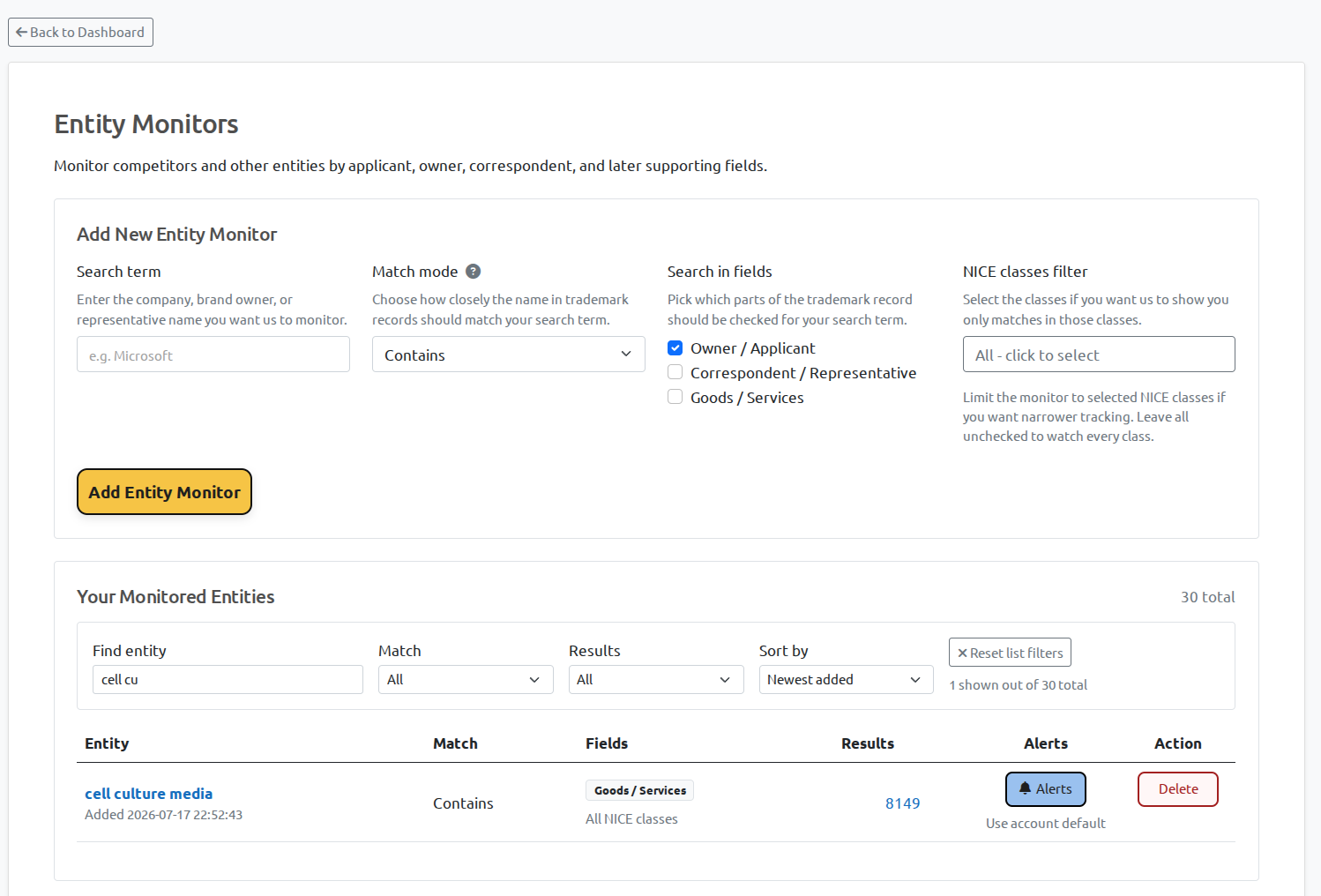
Each monitor keeps its own search term, match logic, watched fields, Nice class filters, result count, and alert settings.
So instead of asking one generic keyword to do everything, BrandCat can track different trademark-intelligence questions separately.
Goods & Services Monitoring Deserves Its Own Workflow
Goods & Services monitoring is especially useful because it does not depend on the trademark name matching your brand.
A filing may have a completely unrelated mark name, but still be relevant because of what the applicant is trying to cover.
For example, a monitor for cell culture media can surface filings where that wording appears inside the specification, even when the mark name itself is something completely different.
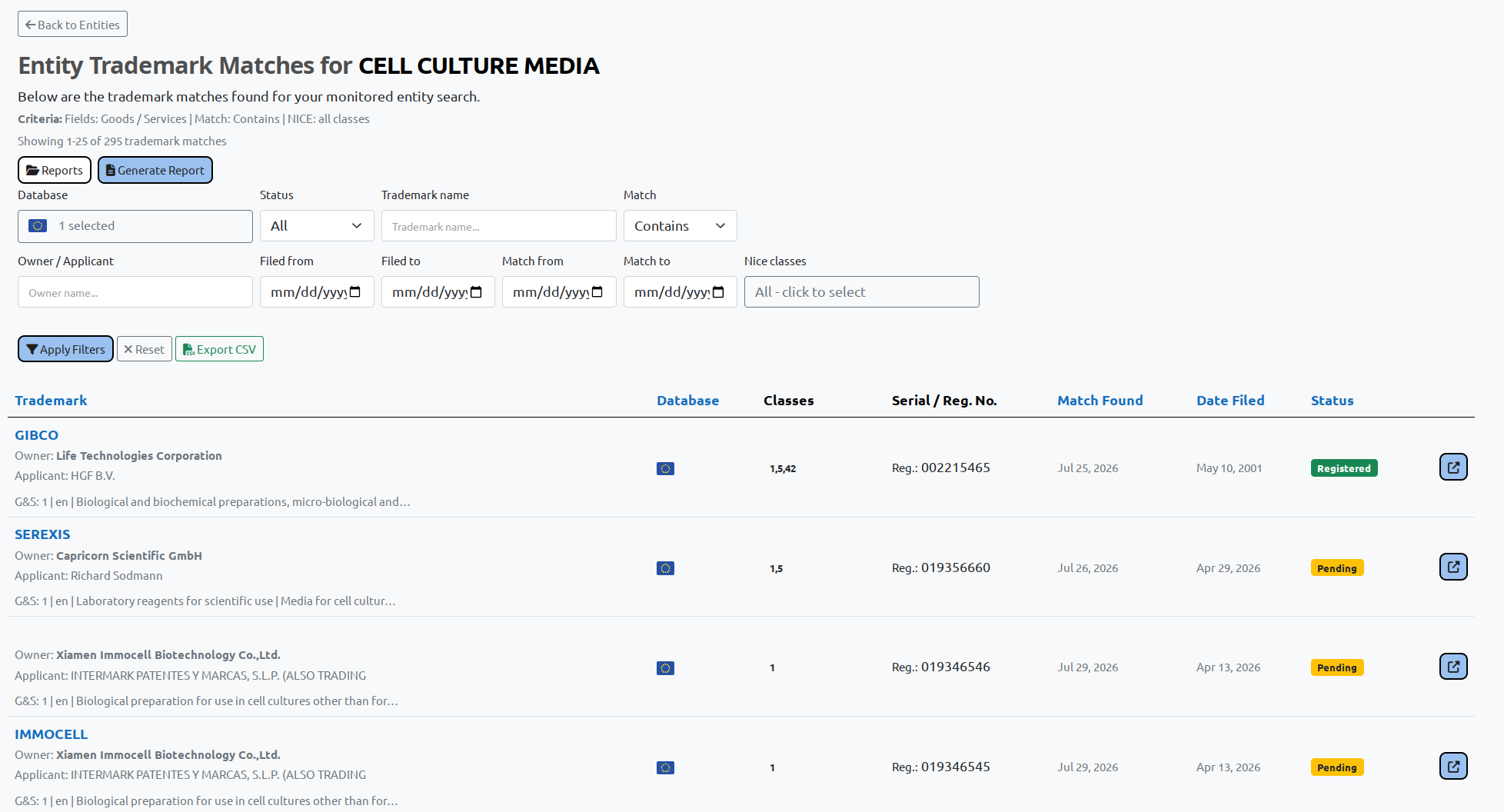
This is useful for product-category monitoring, competitor research, industry watching, and trademark review workflows where the real signal is inside the specification text.
A mark-name watch asks:
Is someone filing something with a similar name?
A Goods & Services monitor can ask:
Who is filing trademarks that cover this product category, technology, ingredient, or service?
That is a different question, and it deserves a separate monitor.
Watch the Same Theme Across Multiple Offices
Entity Monitoring can also be used across different trademark offices.
The same Goods & Services term can produce different result sets depending on the office, the filing language, the age of the records, and the way the registry data is structured.
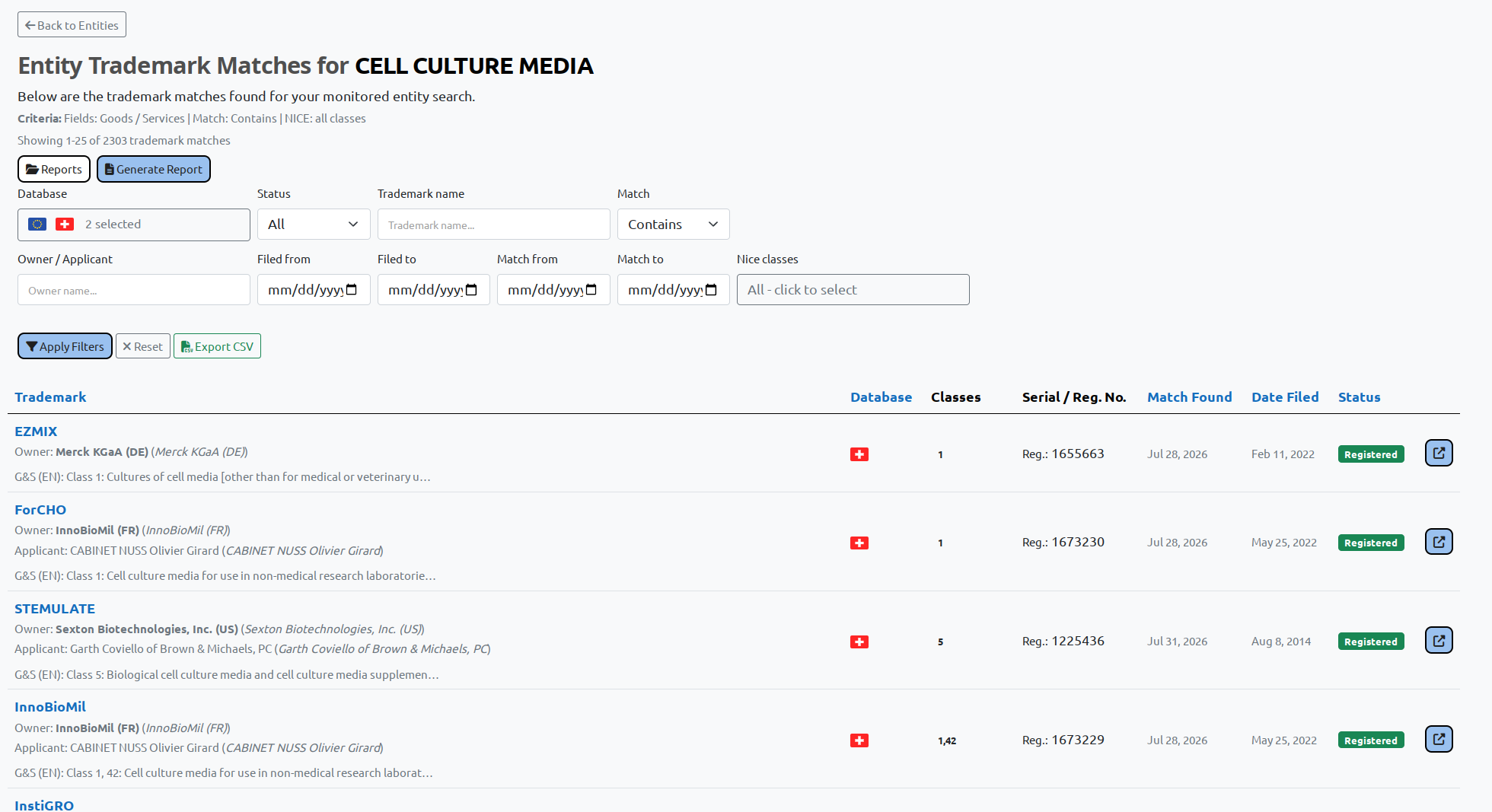
BrandCat keeps the results in the same review workflow, so users can filter, compare, export, and open the underlying filings without rebuilding the same search manually in separate trademark databases.
This is especially useful when monitoring a product category across several markets, or when trying to understand which companies are active in a specific technical or commercial field.
Entity Matches Still Open as Real Trademark Records
Entity Monitoring is not just a summary page.
Each result can be opened as a normal BrandCat trademark detail view, with the underlying filing data preserved.
Depending on the source office and registry data, that can include:
- trademark name
- owner or applicant
- correspondent or representative
- application and registration numbers
- filing, registration, and expiry dates
- status
- Nice classes
- Goods & Services text
- translated fields
- original registry wording
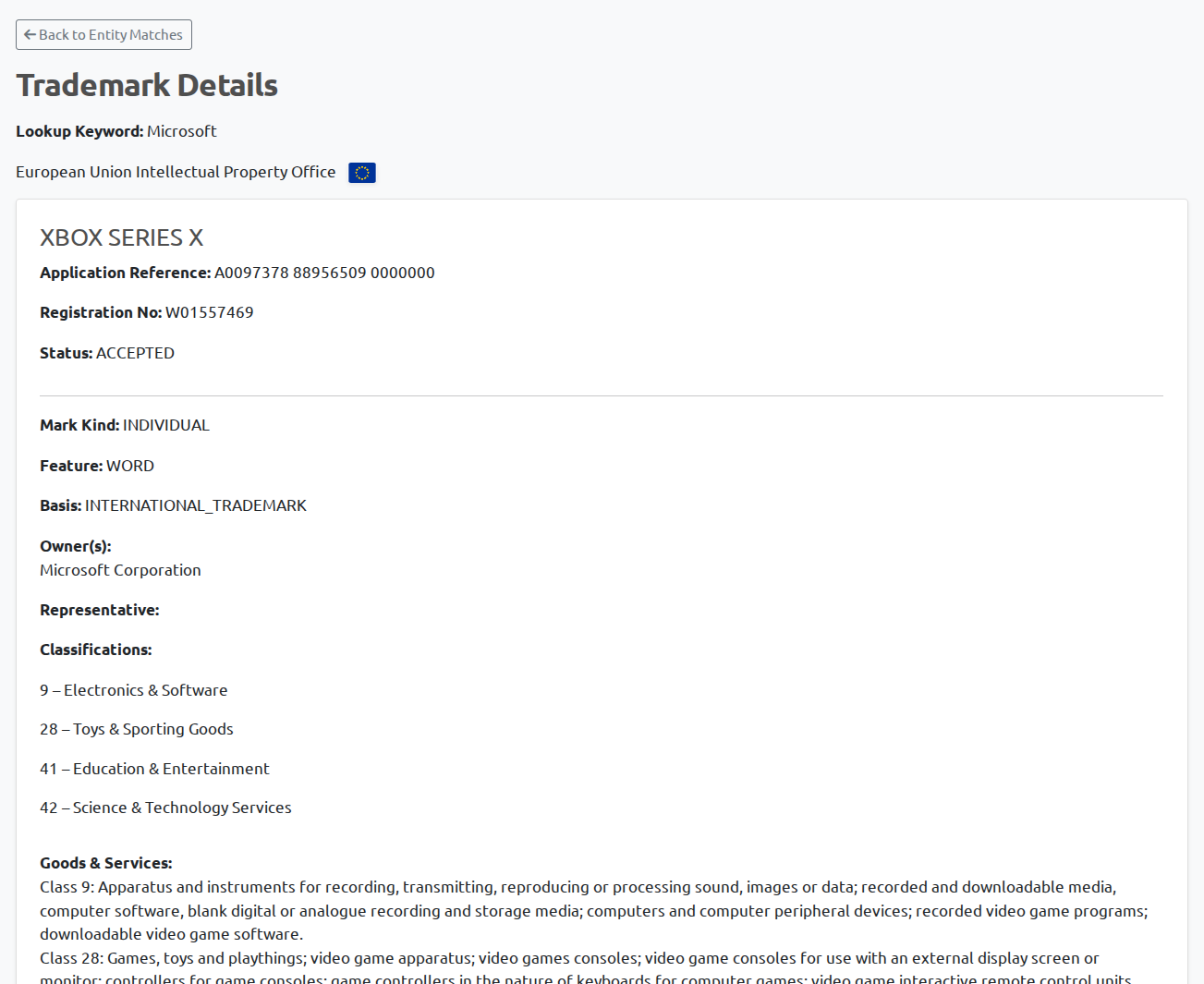
This matters because Entity Monitoring is only useful if the reviewer can move from the signal to the actual filing.
A result should not just say "something matched". It should show the trademark record behind the match.
Owner and Applicant Monitoring
Owner and applicant monitoring helps users track filing activity connected to a company name.
That company might be:
- a competitor
- a distributor
- a portfolio company
- a manufacturer
- a customer
- a potential infringer
- a business entering a new market
Instead of watching only for similar marks, BrandCat can watch for filings connected to the party behind the filing.
This is useful when the question is not "does this mark look like mine?", but:
What is this company filing?
That can reveal new product lines, regional expansion, defensive filing strategies, or activity that would not be visible from mark-name matching alone.
Representative and Correspondent Monitoring
Sometimes the useful signal is not the owner or applicant. It is the representative.
Trademark filings often move through the same law firms, agents, correspondents, or local representatives. Watching those names can help identify patterns around a client, competitor, industry, or filing campaign.
Representative and correspondent monitoring is especially useful when:
- a company files through several subsidiaries
- the owner name is inconsistent across offices
- the same counsel handles related filings
- a local representative appears repeatedly in a specific market
- a reviewer wants to monitor filing activity connected to a known agent or firm
Entity Monitoring makes this part of the trademark record searchable as its own signal.
Nice Class Filters Keep Broad Monitors Under Control
Some entity searches are intentionally broad.
A company name may appear across many different products. A representative may handle filings in many unrelated industries. A Goods & Services term may appear in a large number of records.
BrandCat lets users narrow entity monitors with Nice class filters when they want a more focused watch.
That makes it possible to keep separate monitors such as:
- a broad competitor watch across all classes
- a class-specific competitor watch
- a Goods & Services monitor for one product category
- a representative watch limited to relevant classes
- a category monitor used for reporting or review
The monitor definition stays clear, and the results stay easier to review.
Reports, Alerts, and Review Workflows
Entity Monitoring works with the same practical BrandCat review tools used elsewhere in the trademark workflow.
Users can review matches, filter result lists, export CSV files, generate reports, and configure alerts.
That makes Entity Monitoring useful for both quick checks and recurring review workflows.
A user can create a monitor once, then return to the same result set instead of repeating the same manual searches across multiple registry websites.
Why Entity Monitoring Matters
Trademark intelligence is not only about similar names.
A complete monitoring workflow should also help answer questions such as:
- Who is filing in this category?
- Which competitors are becoming more active?
- Which law firms or representatives are connected to new filings?
- Which filings mention a product or service term we care about?
- Which offices are producing the most relevant results?
- Which results should be reviewed, reported, or watched over time?
Entity Monitoring helps BrandCat move beyond simple mark-name matching and toward a broader trademark intelligence workflow.
It gives users a better way to track the people, companies, counsel, and specification language behind trademark activity.
From Brand Watching to Trademark Intelligence
Brand-name monitoring still matters. It remains one of the fastest ways to catch obvious conflicts and lookalike filings.
But many useful trademark signals do not start with the brand name.
Entity Monitoring adds another layer:
- mark-name watches show similar names
- owner / applicant monitors show who is filing
- representative / correspondent monitors show who is filing for them
- Goods & Services monitors show what the filings cover
Together, these make BrandCat more useful for lawyers, portfolio managers, brand owners, and anyone who needs to understand trademark activity across multiple offices.
Try Entity Monitoring in BrandCat
Entity Monitoring is now available inside BrandCat for advanced trademark monitoring and trademark intelligence workflows.
Use it to watch companies, counsel, representatives, product categories, and Goods & Services language inside the same system you already use for trademark monitoring.
👉 Entity Monitoring: https://brandcat.io/features-entity-monitoring
👉 Trademark monitoring coverage: https://brandcat.io/features-trademark-monitoring
👉 Start monitoring: https://brandcat.io/sign-up
👉 Contact us: https://brandcat.io/contact
