A Trademark Watch Is More Than a Keyword
BrandCat originally grew around monitored keywords.
That made sense when the basic question was:
Has somebody registered a similar domain, launched a similar website, or filed a trademark containing this name?
But as the trademark monitoring side of BrandCat became more advanced, one word started carrying too much responsibility.
A domain watch and a trademark watch may both contain the word GLAZE, but they are not really the same kind of monitor.
A domain watch cares about things such as:
- domain variations
- TLDs
- registration activity
- DNS and website signals
A trademark watch cares about things such as:
- trademark similarity
- filing jurisdiction
- Nice classes
- Goods & Services
- owner or applicant
- filing status
- whether the result actually overlaps with the protected trademark's commercial scope
So we have separated these workflows.
Trademark watches, domain watches, copycat website watches, and Entity Monitors are now handled as their own monitoring types instead of pretending that every monitored thing is simply another generic keyword.
Most of this work is invisible from the outside.
That is fine. Database architecture is not usually the exciting part of a feature announcement. 🙂
What matters is what this lets us do next.
Nice Classes Now Belong to the Trademark Watch
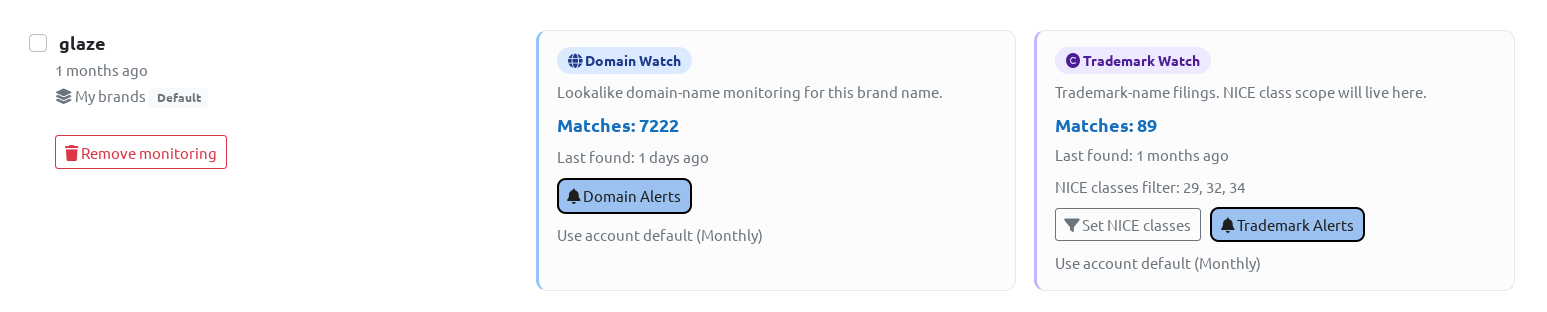
One of the first practical results is that a monitored trademark can now carry its own Nice class scope.
For example, instead of simply monitoring:
GLAZE
a user can define something closer to:
GLAZE Nice Classes: 21, 42, 43
That distinction matters.
The same word can appear in trademark filings covering completely unrelated products and services. A textually similar filing can be interesting, irrelevant, or somewhere in between depending on what each trademark actually covers.
Nice classes are not a substitute for legal analysis, and two marks do not magically become conflicting just because they share a class.
But class information is extremely useful context for the first review.
Attaching that context directly to the watched trademark means BrandCat knows not only what name we are protecting, but also which commercial areas are especially relevant to that watch.
The screenshot below shows the same per-watch Nice class configuration on another monitored trademark:
See the Nice Class Overlap Directly on Every Match
Saving Nice classes with the watched trademark is useful.
Showing the actual overlap while reviewing results is where it becomes much more practical.
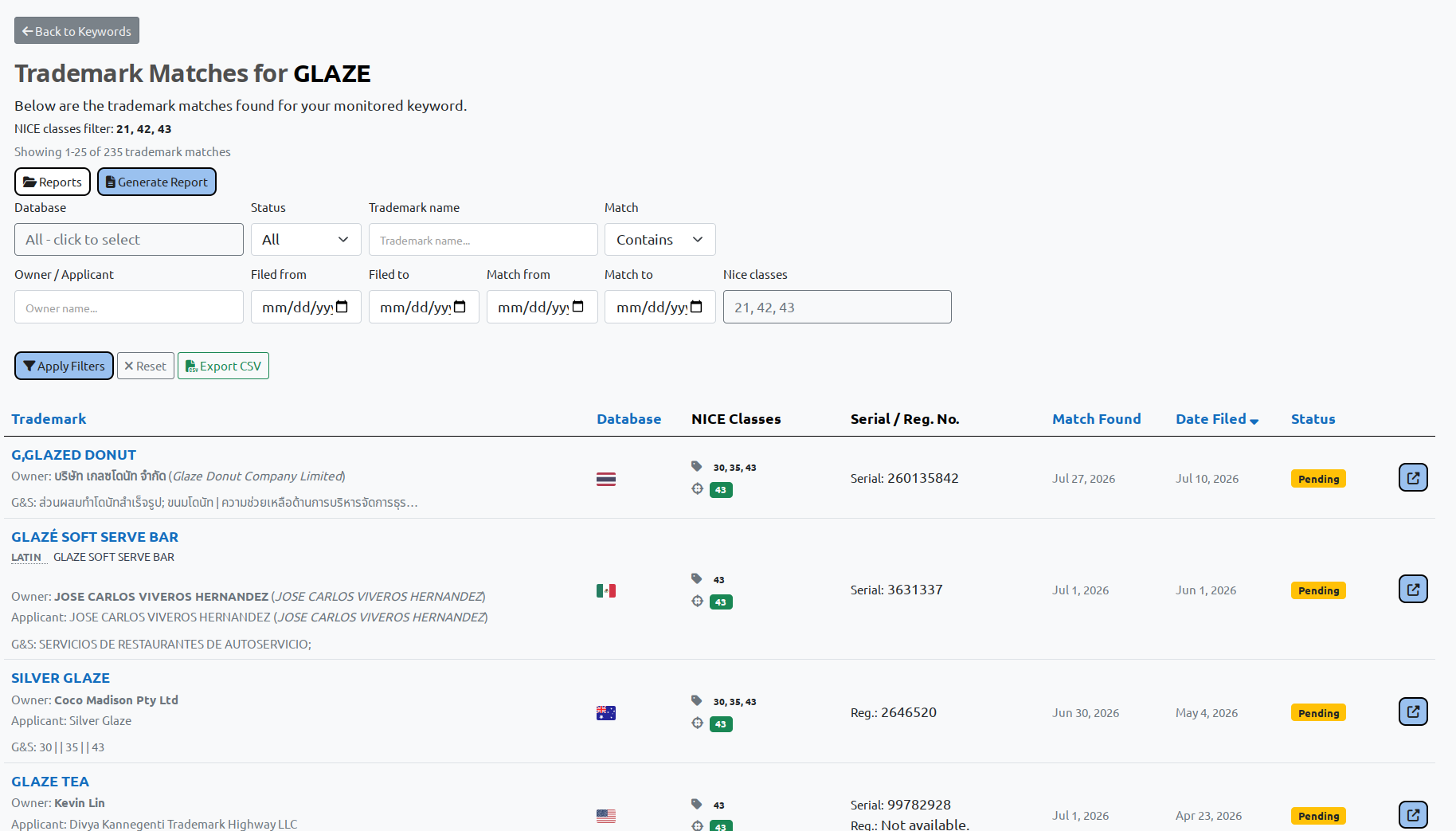
Continuing with the GLAZE example, the watched trademark is configured for:
Watched Nice classes: 21, 42, 43
BrandCat finds a potentially similar trademark filed in:
Classes: 30, 35, 43
The result can now immediately show the relevant overlap:
Matched class: 43
That makes a large result list much easier to scan.
Instead of mentally comparing two lists of class numbers for every result, the reviewer can immediately see which classes caused the filing to overlap with the scope of the watched trademark.
This is especially useful when a result contains many classes.
A filing covering ten or fifteen classes may look broad at first glance, but the reviewer usually wants to know a much simpler thing:
Which of those classes actually overlap with the trademark I am watching?
BrandCat now puts that information directly into the result.
Class-Aware Monitoring Is About Context, Not Automatic Legal Conclusions
There is an important distinction here.
BrandCat is not saying:
Same Nice class = infringement.
Nor is it saying:
Different Nice class = safe.
Trademark conflicts are more complicated than that, and related goods and services can cross class boundaries.
The point is to give the person reviewing the watch better context faster.
A similar-looking mark in exactly the same commercial area will usually deserve a different level of attention from a coincidental name match covering something completely unrelated.
Nice class overlap is therefore one more useful signal alongside:
- mark similarity
- Goods & Services
- owner or applicant
- jurisdiction
- filing date
- status
- other available trademark record data
The reviewer still makes the decision.
BrandCat's job is to make that review less tedious.
Portfolios / Clients: Organize Watches Instead of Keeping One Giant List
The other big addition is Portfolios / Clients.
As users started monitoring more brands, one flat watch list became increasingly awkward.
A law firm may be monitoring trademarks and domains for several clients.
A company may have several brands, product families, subsidiaries, or business units.
An agency may manage several customers.
And a brand owner may simply want to keep unrelated groups of monitored names separate.
BrandCat can now group trademark watches, domain watches, Entity Monitors, and copycat domains under the same Portfolio or Client.

The portfolio manager also shows the monitoring mix at a glance, including counts for trademark watches, domain watches, Entity Monitors, copycat domains, and the total number of monitored items in that group.
Groups can be created as either:
- Client - displayed as a client throughout the app
- Portfolio - the more general option for your own brands, business units, products, or any other grouping
A reference code and notes can also be attached when useful.
For a trademark law firm, the obvious structure might be:
Client A
- Trademark watches
- Domain watches
- Entity monitors
Client B
- Trademark watches
- Copycat domains
For an in-house team, the exact same structure can represent:
- brands
- subsidiaries
- product lines
- regional portfolios
- internal business units
The group also follows the monitored items into the dashboard, reports, and CSV exports, so the organization is not limited to the portfolio-management screen.
The important part is that BrandCat no longer assumes every monitored item belongs in one enormous undifferentiated list.
Portfolio or Client: Use Whichever Fits
"Client" is an obvious word if you are a trademark attorney.
It is less obvious if you are protecting your own company's brands.
That is why BrandCat does not force every group to be a client.
When creating a group, you can choose whether it is a Client or a general Portfolio. Client groups are labelled as clients across the app; everything else remains a portfolio.
So a law firm can organize watches by client, while an in-house brand owner can use exactly the same feature without pretending that its own brands are "clients".
The underlying idea is simple: keep related monitoring activity together, whatever that relationship happens to be.
From a Flat Keyword List to a Structured Trademark Portfolio
These changes may look small individually.
Together, they change the model quite a bit.
Previously, the basic unit of BrandCat monitoring was often:
Here is a keyword. Find things that match it.
Now a trademark watch can increasingly answer several questions at once:
What are we protecting?
The watched trademark.
For whom or for which portfolio?
Its Portfolio / Client group.
In which commercial areas?
Its selected Nice classes.
Why is this result relevant?
BrandCat can show the matching classes and the underlying trademark record.
That is a much better foundation for managing larger trademark portfolios.
It also means BrandCat can keep improving trademark-specific workflows without making domain monitoring, website monitoring, and Entity Monitoring increasingly complicated in the process.
Separate Monitoring Types, One Brand Protection Platform
The goal is not to split BrandCat into several unrelated products.
It is the opposite.
We want each monitoring type to understand the thing it is actually monitoring while keeping the results available inside one BrandCat account.
Today that means dedicated workflows for:
- Trademark Watches - potentially conflicting trademark filings
- Domain Watches - suspicious or similar domain registrations
- Copycat Website Watches - websites that may imitate or misuse a protected brand
- Entity Monitors - owners, applicants, representatives, correspondents, and Goods & Services activity
They solve different monitoring problems.
They should therefore be able to have different settings, matching logic, alerts, filters, and organization.
But the user should not need four unrelated systems to review them.
That is the direction we are building toward.
How This Helps With Real Trademark Review
Consider a law firm monitoring several trademarks for several clients.
Without portfolio and class context, a result list can quickly become:
200 matches for GLAZE
150 matches for HELLER
90 matches for another mark
...and now somebody has to remember which client owns what and which classes actually matter.
With the new structure, BrandCat can keep those relationships attached to the watch itself.
The reviewer can start with the portfolio, open the protected trademark, see its relevant Nice classes, and then review matches with the overlapping classes already identified.
The same idea works for an in-house team.
Instead of mentally reconstructing the portfolio every time somebody opens a result list, more of that context lives in BrandCat.
That does not eliminate trademark review.
It eliminates some of the administrative archaeology around trademark review. 🙂
This Also Builds on Entity Monitoring
Our previous Entity Monitoring update already introduced dedicated monitors for owners, applicants, representatives, correspondents, and Goods & Services, including optional Nice class filters.
The new trademark-watch structure applies the same general principle to protected marks themselves:
different monitoring questions deserve different context.
An Entity Monitor asking:
What is this competitor filing in Class 5?
is not the same thing as a Trademark Watch asking:
Is somebody filing a confusingly similar mark to this protected brand in the classes we care about?
They may use some of the same trademark data, but they are different workflows.
BrandCat now treats them that way.
What Changed
The latest trademark monitoring work includes:
- dedicated trademark-watch structures separate from domain and copycat monitoring
- Nice classes attached directly to individual trademark watches
- class-aware trademark result review
- visible Nice class overlap between the watched trademark and matched filing
- Portfolios / Clients for grouping trademark watches, domain watches, Entity Monitors, and copycat domains
- a cleaner foundation for portfolio-level trademark monitoring
- continued separation of Trademark Watches, Domain Watches, Copycat Website Watches, and Entity Monitors
The result is not another trademark database added to the coverage map.
This time the improvement is in the workflow itself.
From Trademark Monitoring to Trademark Watch Management
BrandCat still does the same basic thing it was built to do:
find potentially relevant activity before it becomes easy to miss.
But as the platform grows, finding a match is only one part of the problem.
The next questions are:
- Which protected mark does this belong to?
- Which client or portfolio are we reviewing?
- Which Nice classes matter?
- Where exactly is the overlap?
- Which results deserve closer attention?
- How do we keep all of this organized as the watch list grows?
The latest changes are aimed at those questions.
We are continuing to turn BrandCat from a collection of monitoring signals into a more structured workflow for lawyers, brand owners, IP teams, and anyone managing more than a handful of protected names.
And yes, there will still be more trademark offices too. 🙂
👉 Trademark monitoring: https://brandcat.io/features-trademark-monitoring
👉 Entity Monitoring: https://brandcat.io/features-entity-monitoring
👉 Start monitoring: https://brandcat.io/sign-up
👉 Contact us: https://brandcat.io/contact
