BrandCat continues expanding its trademark monitoring capabilities across Asia.
Following the recent addition of support for the Korean Intellectual Property Office (KIPO), we've rolled out two additional improvements that make trademark monitoring in China, Japan and Korea significantly easier:
- Automatic translation of owner and correspondent names and places (e.g. if owner is listed "デュオリンゴ・インコーポレイテッド" in Japanese, you will also get a result if you enter "DuoLingo Incorporated")
- Flexible trademark name filters (Contains / Begins / Ends / Exact)
These upgrades help users analyze trademark filings in non-Latin scripts more easily and refine search results more precisely.
Better Visibility into Chinese, Japanese and Korean Trademark Data
Trademark registries in East Asia frequently store owner and applicant information in local scripts:
- Chinese (CNIPA)
- Japanese (JPO)
- Korean (KIPO)
While these records are accurate, they can be difficult to interpret quickly if you do not read the language.
BrandCat now automatically translates owner and correspondent information when displaying trademark details and monitoring results.
Example: CNIPA Trademark Detail with Translation
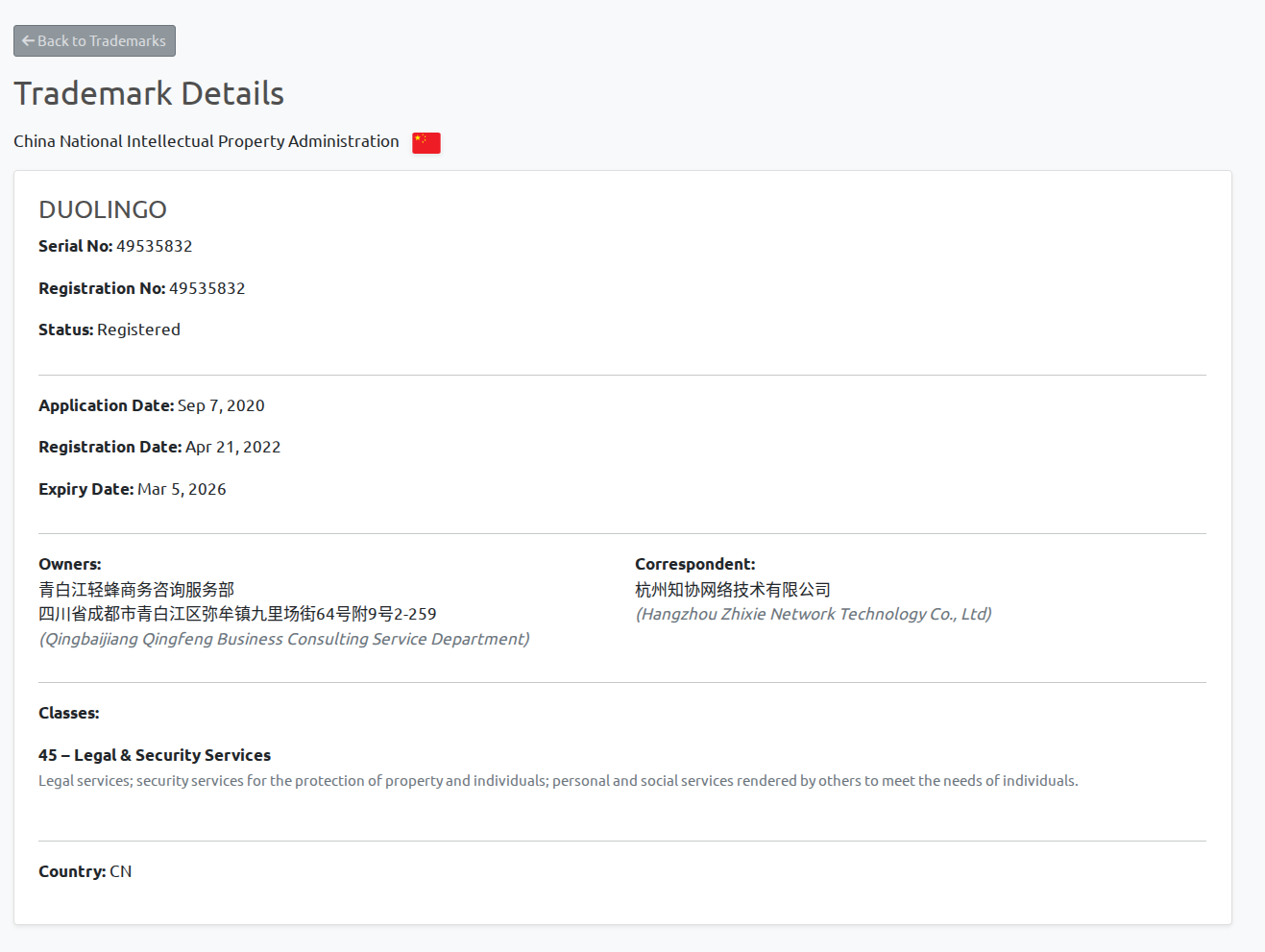
In the example above:
- The original Chinese owner name is shown first
- The English translation appears directly below in parentheses
This allows users to quickly understand who owns a mark without losing the original legal record.
Unified Display Across Asian Trademark Offices
The same translation support is available across all supported Asian trademark offices.
Example: Searching Japanese Trademarks in Japanese and Latin Scripts
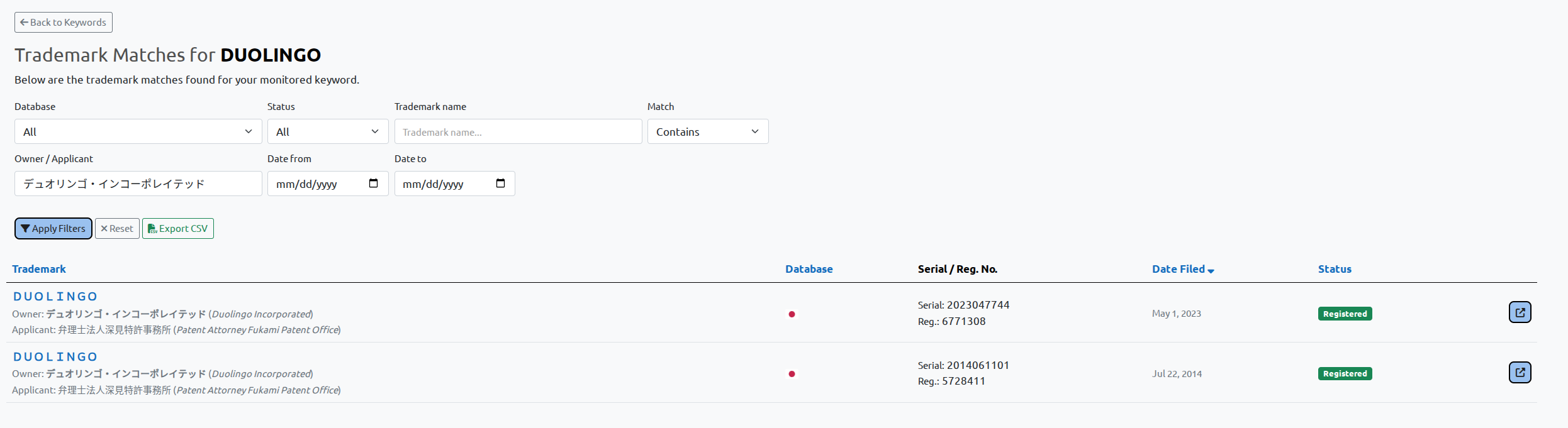
BrandCat allows searching Japanese trademark records using both the original Japanese script and Latin-character equivalents of the trademark owner or applicant name. This makes monitoring easier even if you are not familiar with Japanese writing systems.
Search using Japanese Katakana
Search using Latin script (English / translated name)
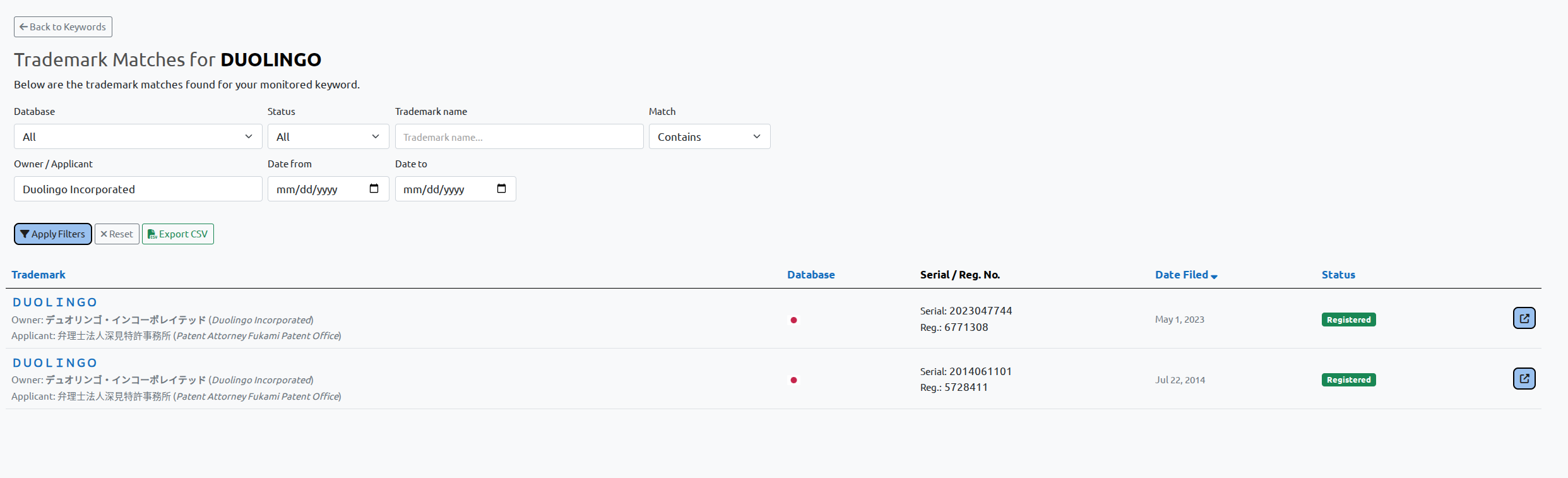
Both searches return the same trademark filings, demonstrating how BrandCat normalizes Japanese trademark data and translations so users can discover filings regardless of whether the search query is written in Japanese script or Latin characters.
Improved Trademark Name Filters
We also introduced more precise trademark name filters in the monitoring dashboard.
Users can now choose how trademark names are matched against their monitored keywords.
Available Matching Modes
| Filter | Description |
|---|---|
| Begins | Trademark name starts with the keyword |
| Contains | Keyword appears anywhere in the mark |
| Exact | Trademark name matches exactly |
| Ends | Trademark name ends with the keyword |
Example: Trademark Filter Options
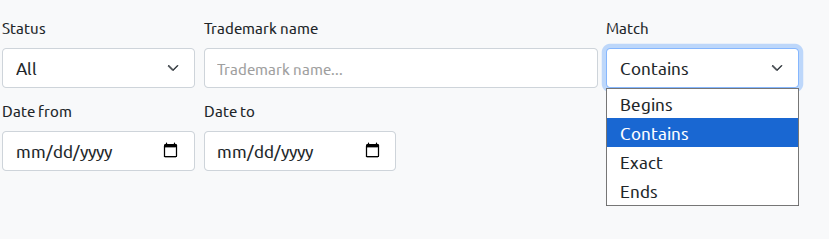
These filters allow users to refine monitoring results depending on how strict they want the matching to be.
For example:
- Contains – useful for broad monitoring
- Begins – helpful for prefix-style brand names
- Exact – ideal for detecting direct copies
- Ends – useful for suffix patterns like "-CAT", "-TECH", etc.
Example: Filtered CNIPA Trademark Results
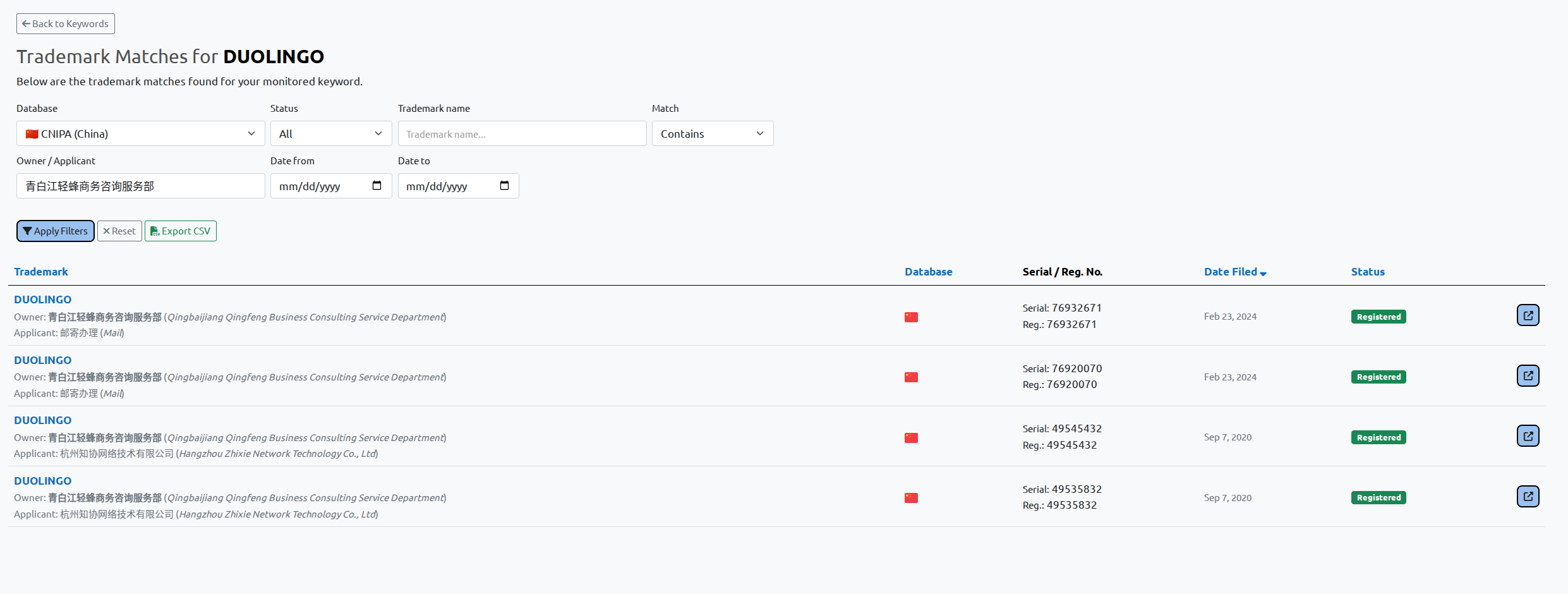
The monitoring table now shows:
- Translated owner information
- Translated applicant information
- Filing dates and registration numbers
- Direct links to detailed trademark records
This helps users quickly scan large result sets.
Supported Trademark Offices
BrandCat currently monitors trademark activity across major global registries, including:
- 🇺🇸 USPTO – United States
- 🇨🇳 CNIPA – China
- 🇪🇺 EUIPO – European Union
- 🇬🇧 UKIPO – United Kingdom
- 🇯🇵 JPO – Japan
- 🇰🇷 KIPO – Korea
- 🇦🇺 IP Australia
- 🇨🇦 CIPO – Canada
- 🇳🇿 IPONZ – New Zealand
- 🇨🇭 IGE – Switzerland
Why This Matters
Trademark monitoring across international registries often involves:
- Multiple languages
- Different scripts
- Different registry formats
BrandCat normalizes this information into a single unified interface so brand owners can review potential conflicts quickly.
These improvements make monitoring in Asia significantly easier while keeping the original registry data visible.
What's Next
We're continuing to improve BrandCat's trademark intelligence features, including:
- Improved phonetic similarity detection
- Cross-office conflict clustering
- Enhanced reporting and export tools
- Additional global trademark offices
Translation Support for Non-Latin Scripts
BrandCat currently focuses translation support on trademark registries that primarily use non-Latin scripts, such as Chinese, Japanese and Korean.
For languages that already use the Latin alphabet as their primary writing system, translation features are generally less critical. For example, names written in Spanish or Portuguese are typically readable for most users, while scripts like 東京 or 北京市 may not be immediately recognizable.
For that reason, BrandCat currently prioritizes translations for jurisdictions using non-Latin alphabets. This approach helps users quickly understand ownership and correspondent information without removing the original registry text.
In the future, we plan to continue supporting translations for additional languages and scripts where it provides real value, including:
- Hindi
- Russian
- Armenian
- Georgian
- Bulgarian
As always, feature priorities are also influenced by user feedback. If translations for additional jurisdictions are helpful for your workflow, feel free to let us know.
Start protecting your brand globally with BrandCat:
