Domains are often one of the first visible signs of brand abuse, phishing, impersonation, suspicious redirects, affiliate activity, or copied pages.
Finding a matching domain is useful, but the domain name alone is rarely enough to decide what to do next. After a domain appears in monitoring results, someone still has to check whether it resolves, whether it shows a real website, where it redirects, who registered it, who hosts it, and whether there are useful registrar or hosting contacts.
That review work is what we wanted to make faster.
BrandCat's domain monitoring results now include a richer evidence layer, so users can review matched domains with more context directly inside the product.
From domain list to evidence view
For a large brand, domain monitoring can return hundreds or thousands of matches across different extensions. Some domains are parked, some are inactive, some redirect elsewhere, and some host real websites. A few may also share the same infrastructure, registrar, hosting provider, or redirect pattern, but that is not obvious from the domain names alone.
BrandCat now adds evidence directly to the domain monitoring workflow. Instead of showing only the matched domain, the results table can show context that helps reviewers decide whether a result is worth opening, ignoring, hiding, exporting, or investigating further.
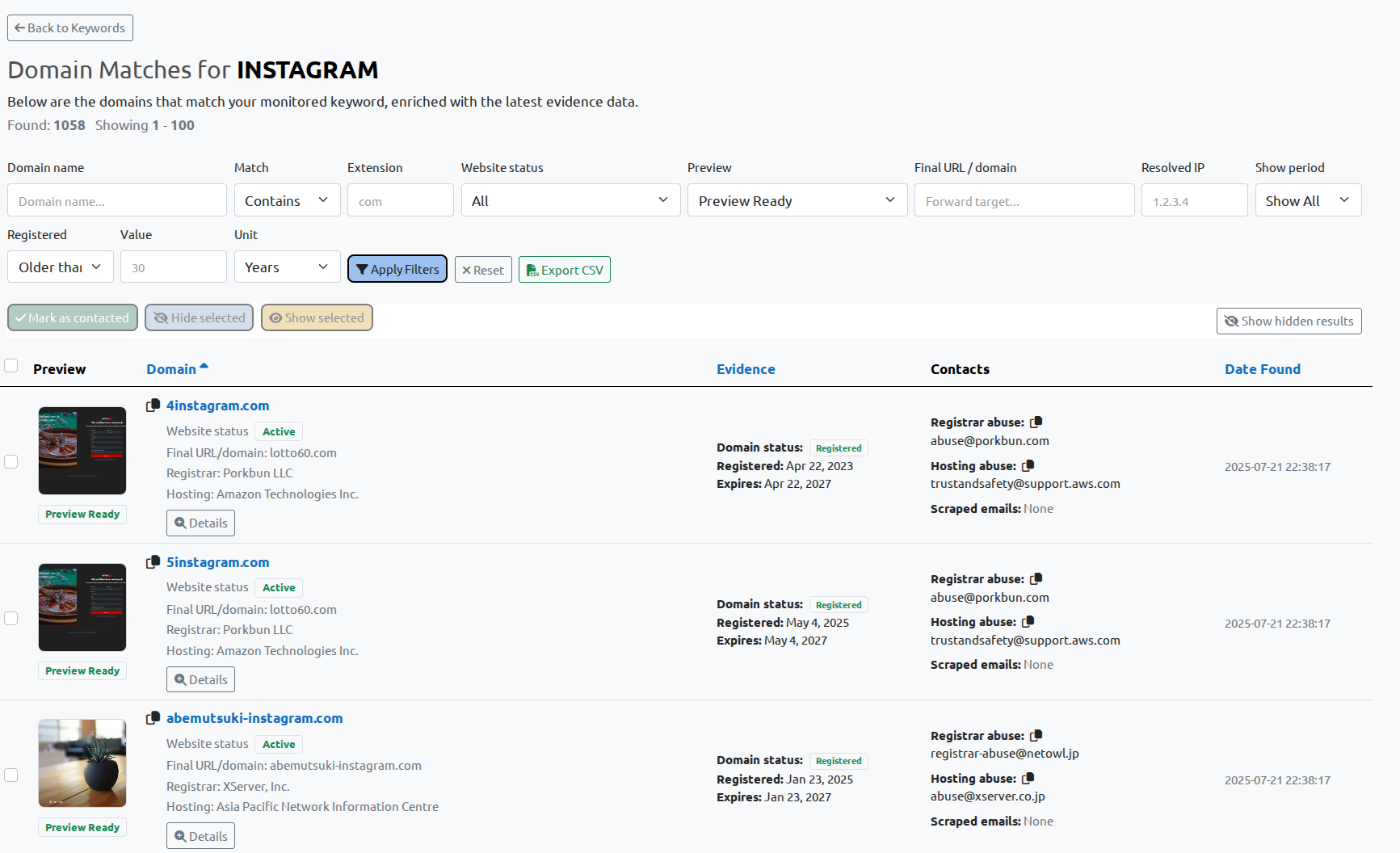
The list view gives reviewers a faster first pass. It can show website previews, website status, final URL, registrar, hosting provider, registration dates, abuse contacts, scraped emails where available, screenshot status, and evidence-aware filters.
This makes it easier to separate active websites, redirects, parked domains, recently registered domains, shared infrastructure, and lower-priority results.
A domain details page for deeper review
The list view is useful for scanning many results, but some domains need a closer look. BrandCat now has a dedicated domain details page, built in the same general style as our trademark detail pages.
Instead of treating a matched domain as only one row in a table, BrandCat gives each domain its own evidence page.
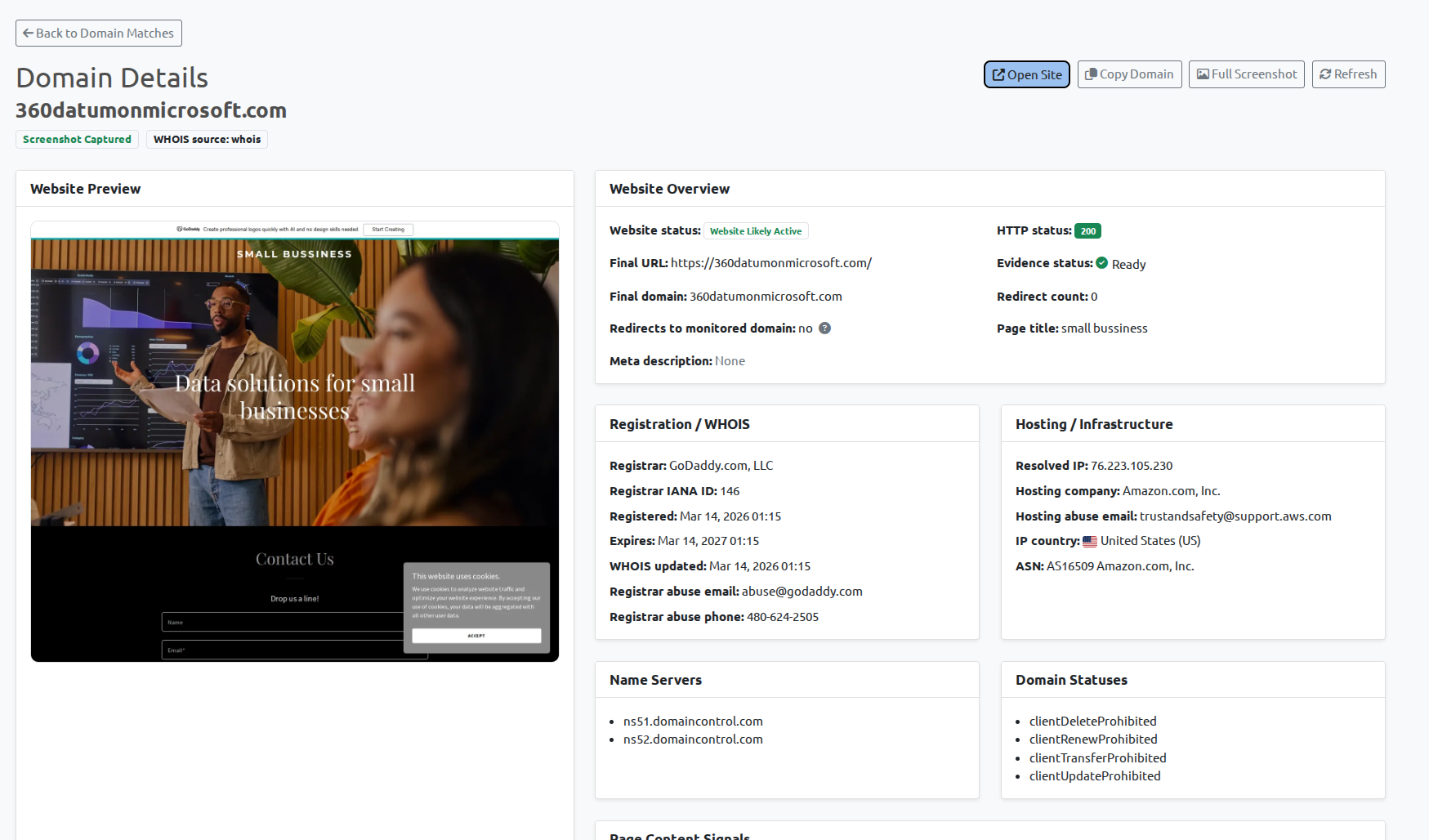
The domain details page brings together the website preview, website status, HTTP status, final URL, final domain, redirect count, page title, meta description, WHOIS data, registrar information, hosting/IP evidence, country, ASN, nameservers, domain statuses, and raw WHOIS/RDAP data where available.
This keeps the review workflow inside BrandCat. The live domain link still opens the actual website, while the details page stays inside BrandCat as the internal evidence record.
Website preview and website overview
A domain name can only tell you so much. The page itself often gives the reviewer much more useful context.
BrandCat captures website screenshots for matched domain results, so users can quickly see what the domain showed at the time of review. The screenshot is not meant to make an automatic judgment about the site. It simply gives the reviewer visual context.
The website overview also stores practical page-level information such as the final URL, final domain, HTTP status, redirect count, page title, and meta description.
This is useful because matched domains can behave in different ways. Some domains resolve directly. Some redirect. Some show a landing page. Some show a parked page. Some return errors. Some have a title and meta description that make the site's purpose easier to understand.
By showing this information together, BrandCat reduces the number of external checks needed during review.
WHOIS and registrar evidence
Domain registration data is still an important part of domain review. Even when registrant information is hidden by privacy protection, WHOIS or RDAP records can still provide useful operational details.
BrandCat now brings WHOIS/RDAP evidence into the domain details page.
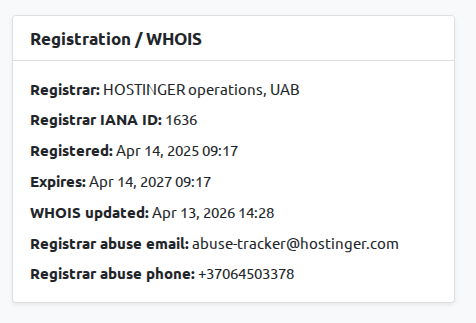
The registration and WHOIS section can show the registrar, registrar IANA ID, registration date, expiration date, WHOIS updated date, registrar abuse email, and registrar abuse phone.
This helps reviewers understand when a domain was registered, who the registrar is, and which registrar contact may be relevant if the domain needs further action.
A recently registered domain is not the same kind of signal as a domain that has existed for many years. A domain with clear registrar abuse contact information is also easier to route into a review or escalation workflow.
Hosting and infrastructure evidence
Registrar data tells you where the domain is registered. Hosting and IP evidence can help show where the website appears to be served from.
BrandCat now collects and displays hosting/IP evidence for matched domains.
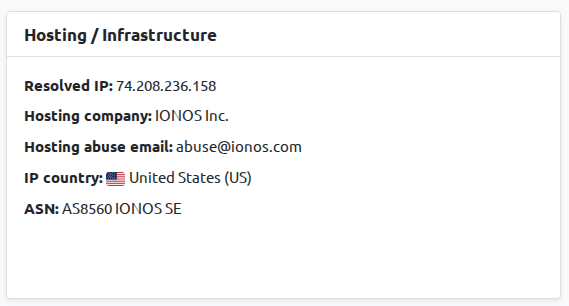
The hosting and infrastructure section can show the resolved IP, hosting company, hosting abuse email, IP country, and ASN.
This is useful because multiple domains may share the same hosting provider, IP range, ASN, or infrastructure pattern. That does not automatically mean the domains are abusive, but it gives reviewers another way to group and prioritize results.
For example, if several matched domains point to the same IP address or the same hosting network, a reviewer may want to inspect them together instead of treating each one as a completely separate item.
Redirects and final URLs
Many domains do not stay on the first URL that appears in the monitoring result. They may redirect to another domain, a subdomain, a parked page, a marketplace page, a regional landing page, or a completely different website.
BrandCat stores redirect-related evidence, including the final URL, final domain, redirect count, and redirect chain where available.
This helps reviewers understand what the domain actually does after it is opened. A domain that redirects is different from a domain that serves its own content directly. A redirect to a monitored or protected domain may also need different interpretation from a redirect to an unrelated destination.
The details page keeps this redirect evidence attached to the domain record so the reviewer does not need to reconstruct it manually.
Filtering domain matches by evidence
When a monitoring account has many domain results, filtering becomes just as important as collecting the data.
BrandCat's domain results now support evidence-aware filters, including domain name, match type, extension, website status, screenshot/preview status, final URL or final domain, registration age, resolved IP, and show period.
This allows users to review domain results in smaller groups. For example, a user can look at active .com domains, domains with screenshots, recently registered domains, domains that resolve to a specific IP, or domains that have already been reviewed and hidden.
The point is to make large result sets easier to work with. A raw list of domains is useful for detection, but a review queue needs filters, evidence, and status fields.
Shared infrastructure signals
A single matched domain may not tell much by itself. Several matched domains using similar infrastructure can be more useful to review together.
That is one reason BrandCat added resolved IP data and IP-based filtering. If multiple domains resolve to the same IP or appear under the same hosting network, users can group them and look for patterns.
This can be useful for reviewing copied sites, recurring redirect behavior, repeated landing page templates, suspicious clusters, or simply domains that belong in the same infrastructure review.
Shared infrastructure does not prove anything by itself, and BrandCat does not treat it as automatic proof of abuse. It is an evidence signal that helps users review results more efficiently.
Copycat matches can use the same evidence model
BrandCat's domain monitoring is not limited to domain-name matches. BrandCat can also surface copycat-style matches based on first-page content similarity.
Those copycat matches can use the same evidence model as normal keyword-based domain matches. That means copycat results can also receive screenshots, preview thumbnails, redirect data, final URL, final domain, page title, meta description, WHOIS fields, and hosting evidence.
This is useful because a copycat page may not always use a domain name that contains the protected brand keyword. In those cases, the page content and evidence record become more important than the domain string itself.
Using the same evidence model for both keyword-based matches and content-similarity matches keeps the review workflow consistent.
Built for review, not automatic accusations
BrandCat does not mark every matched domain as malicious.
A domain match is a signal. A screenshot is a signal. A redirect is a signal. A registration date is a signal. Hosting and IP data are also signals.
The purpose of the evidence system is to put those signals in one place so a human reviewer can decide what matters.
Some matched domains may be legitimate. Some may be unrelated. Some may be parked. Some may be commercial sites. Some may need legal, brand protection, security, or abuse review.
The product should help users make that distinction faster, without pretending that every match is automatically a problem.
What changed in BrandCat
BrandCat's domain monitoring evidence system now helps users review matched domains with:
- website previews
- full domain details pages
- website status and HTTP status
- final URL and final domain
- redirect count and redirect chain
- page title and meta description
- domain WHOIS / RDAP data
- registrar and registrar abuse contacts
- hosting / IP evidence
- resolved IP
- IP country
- ASN
- hosting abuse contacts where available
- nameservers
- domain statuses
- evidence-aware filters
- support for both keyword-based domain matches and copycat/content-similarity matches
This makes BrandCat more useful as a domain monitoring and review workflow, not just a raw list of matching domains.
Start monitoring domains around your brand
BrandCat monitors domain activity across more than 2000 domain extensions and helps users review matched domains with richer evidence, including screenshots, WHOIS/RDAP, hosting data, redirect information, and infrastructure signals.
If you are reviewing domain activity around a brand, product, company, or protected name, BrandCat can help you detect matching domains earlier and review them more efficiently.
Or contact us to discuss your monitoring needs:
